Projects
We pursue projects that integrate perception, cognition, and action to enable intelligent agents to learn autonomously and interact effectively with the physical world.
Featured
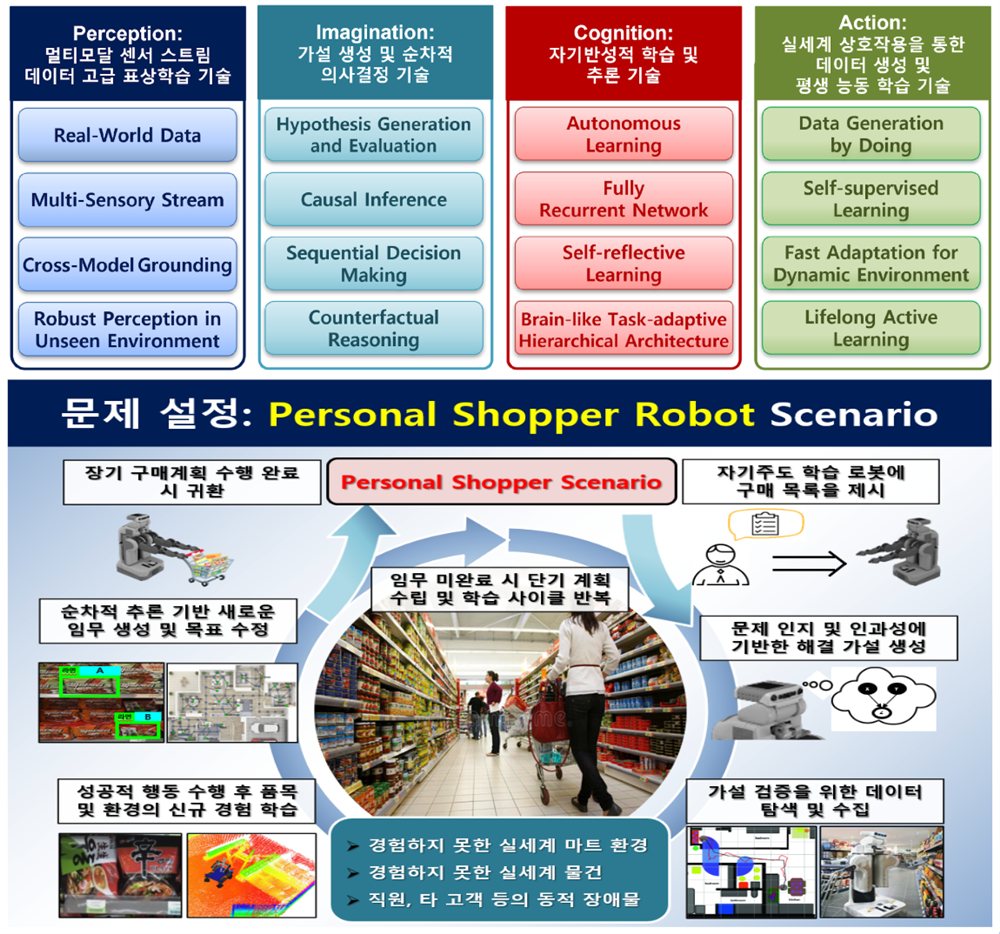
PICA
(Perception, Imagination, Cognition, Action)
새로운 문제를 새로운 상황에 대해
❶ 스스로 문제를 인지하고, 이를 해결하기 위한
❷ 탐색 기반 가설 생성 및 평가와
❸ 필요한 데이터의 자동 탐색, 분석을 통하여
❹ 순차적 추론을 통한 문제 해결을 위해
스스로 학습하는 ‘자기주도 인공지능’
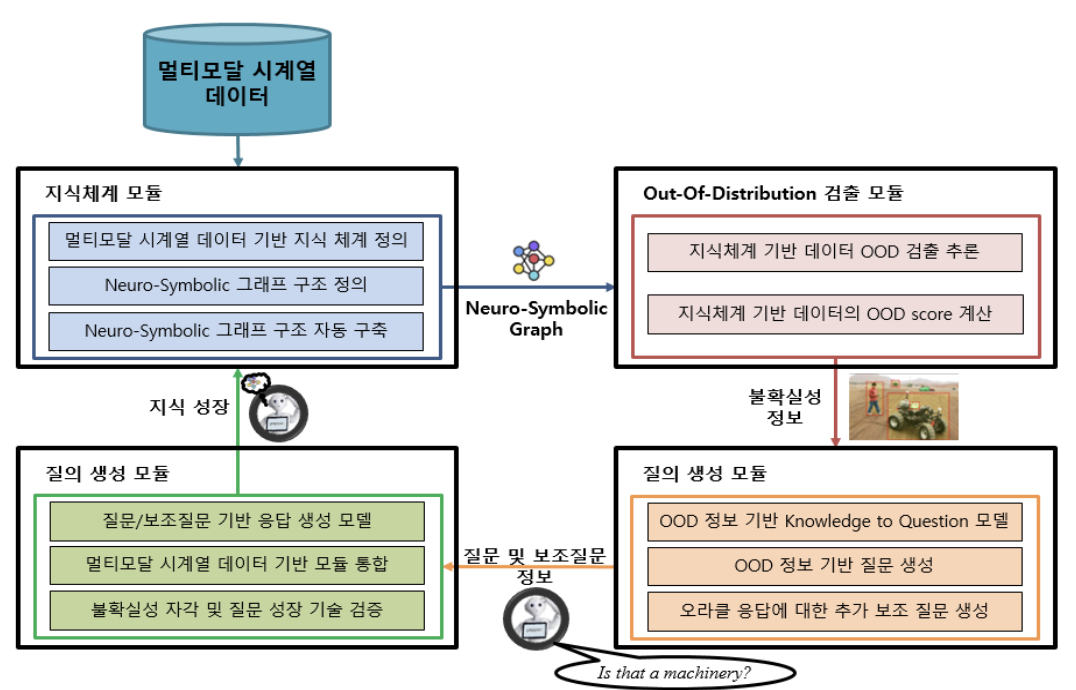
LBA
(Learning By Asking)
불확실한 환경 이해를 위한 능동적 질의 생성 기술
❶ 불확실성 최소화를 위한 질의 및 샘플 생성 기반의 환경 이해
❷ 능동적인 질의응답을 통해 에이전트의 불확실한 초기 지식을 성장시키는 기술 개발
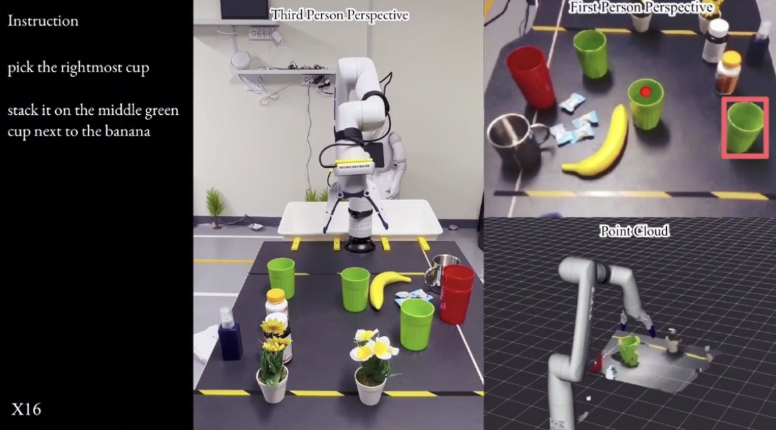
Embodied AI
(Robotics Foundation Models)
Multimodal Perception of Mobile Robots
❶Object detection, Multi-Agent Map Merging, Visual Grounding and Manipulation 등 로봇 AI 기술 개발
❷다중 주행로봇의 2D Map 병합 기술 개발
Arm Robot 조작 관련 체화된 AI 행동 기술
❶ROS 기반 실세계 로봇 제어 시스템 개발
❷자연어 기반 로봇 평생 학습 기술 개발
❸필요 물체 관측 가능 여부를 인지 및 물체 위치 추적 기술
Current Projects
- Learning By Asking (LBA): Developing AI agents aware of their uncertainty that can actively learn by asking questions.
- Tank: Developing autonomous tank crew algorithms using deep reinforcement learning techniques for enhanced operational capabilities.
- KAI: Developing AI algorithms using reinforcement learning for autonomous fighter jet operation and tactical decision-making.
- Embodied AI: Research and development of embodied AI systems possessing physical forms to interact with and learn from the real world.
- Alchemist: Project Alchemist focuses on advancing humanoid robotics capabilities to the next level, enhancing mobility, interaction, and intelligence.
- GSAI: Researching and developing large-scale foundational behavior models for embodied AI agents to effectively solve complex real-world problems.
- 자기주도: Developing self-directed AI capable of autonomous problem identification, hypothesis generation, data acquisition, and sequential reasoning for continuous learning and problem-solving.
- AI Hub: Developing a Universal Learning Machine (ULM) via an open collaborative framework, enabling continuous self-learning and performance improvement in machine learning algorithms.
Completed Projects
2020s
| Project | Period | Description |
|---|---|---|
| Embodied Intelligence | 2023 | Embodied AI for real-world perception and robot manipulation |
| BabyMind | 2020 | Infant-mimic neurocognitive developmental machine learning |
| Video Turing Test (VTT) | 2017–2021 | Human-level AI comprehension of video narratives; DramaQA benchmark |
2010s
| Project | Period | Description |
|---|---|---|
| StarLab | 2015– | Cognitive agents learning everyday life from wearable sensors |
| Molecular AI | 2014–2018 | Intelligent nanobio agents that learn in biomolecular environments |
| CogHRI | 2012–2017 | Cognitive human-robot interaction as moving target tracking |
| Molecular ML | 2012–2015 | Bio-inspired human-level machine learning via DNA computing |
| Videome | 2011–2015 | Cognitive machine learning from digital video streams |
| mLife | 2010–2015 | Human mobile behavior identification from smartphone sensors |
| RoboMotion | 2011–2013 | Learning robot motions from observed human activity sequences |
| BrainNet | 2010–2013 | Uncovering hyperedge structure in cortical brain graphs |
| DietAdvisor | 2011–2012 | Smartphone agent for personalized meal and exercise recommendations |
| DeepAction | 2013–2016 | Deep learning of TV viewer activities |
| DeepClone | 2013–2016 | Behavioral cloning for personal service robot scheduling |
2000s
| Project | Period | Description |
|---|---|---|
| MARS | 2009–2010 | Multimodal associative recommendation system |
| E-Learn | 2009–2010 | Personalized e-learning with Bayesian networks |
| Lavatar | 2009 | Learning avatars in virtual worlds |
| MMG | 2007–2010 | Cognitive learning via the multimodal memory game |
| Xtran | 2008–2010 | Crossmodal translation between language and vision |
| SKT Hypernetwork | 2007–2008 | Hypernetwork models for language learning |
| HyperSNP | 2007–2008 | Hypergraph modeling for large-scale SNP data analysis |
| ProMiR | 2004–2007 | Probabilistic prediction of microRNA genes |
| DNAChipBench | 2002–2007 | Intelligent design and analysis platform for DNA chips |
| MEC | 2000–2009 | Molecular evolutionary computing (Phases I–III) |
| LaText | 2001–2004 | Text mining based on latent variable models |
| BrainGene | 2001–2003 | Gene expression analysis for vertebrate brain development |
1990s
| Project | Period | Description |
|---|---|---|
| LEONN | 1998–2001 | Learning and evolution of neural network architectures |
| FACT | 1998–2001 | Text filtering and classification from large-scale document collections |
| MACS | 1996–1999 | Evolving cooperative behaviors of multiple robotic agents |